
What is PRP?
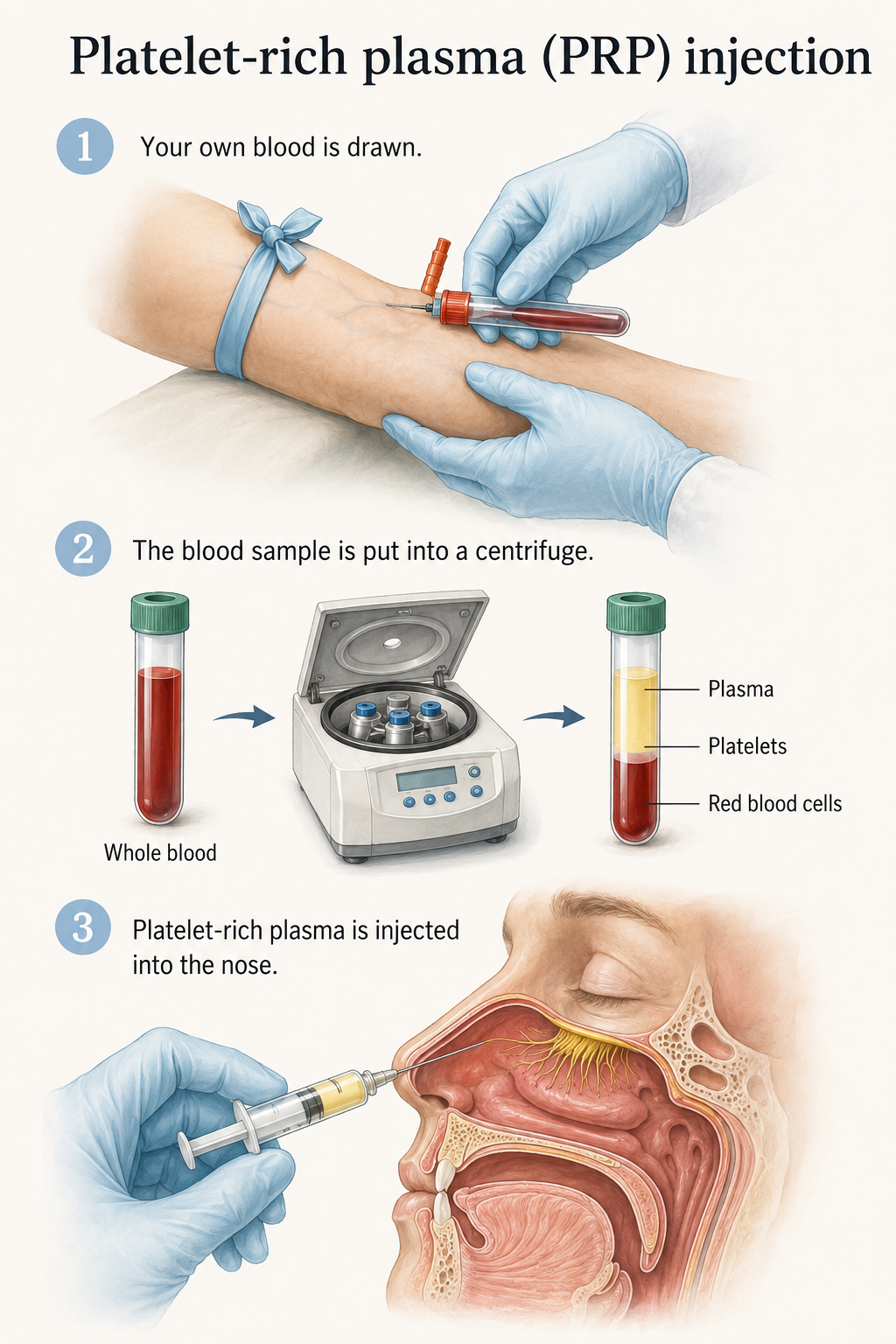
Platelet-rich plasma, or PRP, is made by drawing a small sample of your own blood and concentrating the platelets, which contain growth factors that may support tissue healing. For smell loss, PRP is applied inside the nose near the smell receptors.
Who may be a candidate?
This may be considered for selected patients with persistent smell loss, particularly when other causes have been evaluated and standard treatments such as smell training have not fully restored smell.
What happens during the procedure?
A small blood sample is taken and processed to concentrate the platelets. Using nasal endoscopy, the PRP is then applied directly to the smell receptor area inside the nose. The procedure is done in the office and does not require general anesthesia.
Side effects are usually minimal. The main issue is temporary discomfort during the procedure. Significant adverse effects are uncommon.
What to expect afterward
Most people resume normal activity the same day. Any improvement in smell tends to happen gradually, over weeks to months, rather than immediately.
The evidence is still evolving. Early research on PRP for smell loss is encouraging, but this remains a newer treatment, and it is not yet established as a routine or guaranteed therapy. It's typically considered alongside, not instead of, other evidence-based treatments such as smell training.