
What Is Cerebrospinal Fluid?
Cerebrospinal fluid, often shortened to CSF, is the clear fluid that surrounds and cushions the brain and spinal cord.
What Is a CSF Leak?
A CSF leak from the nose happens when there is an opening in the skull base that allows this fluid to leak into the nose. It can happen after an injury or surgery, or on its own.
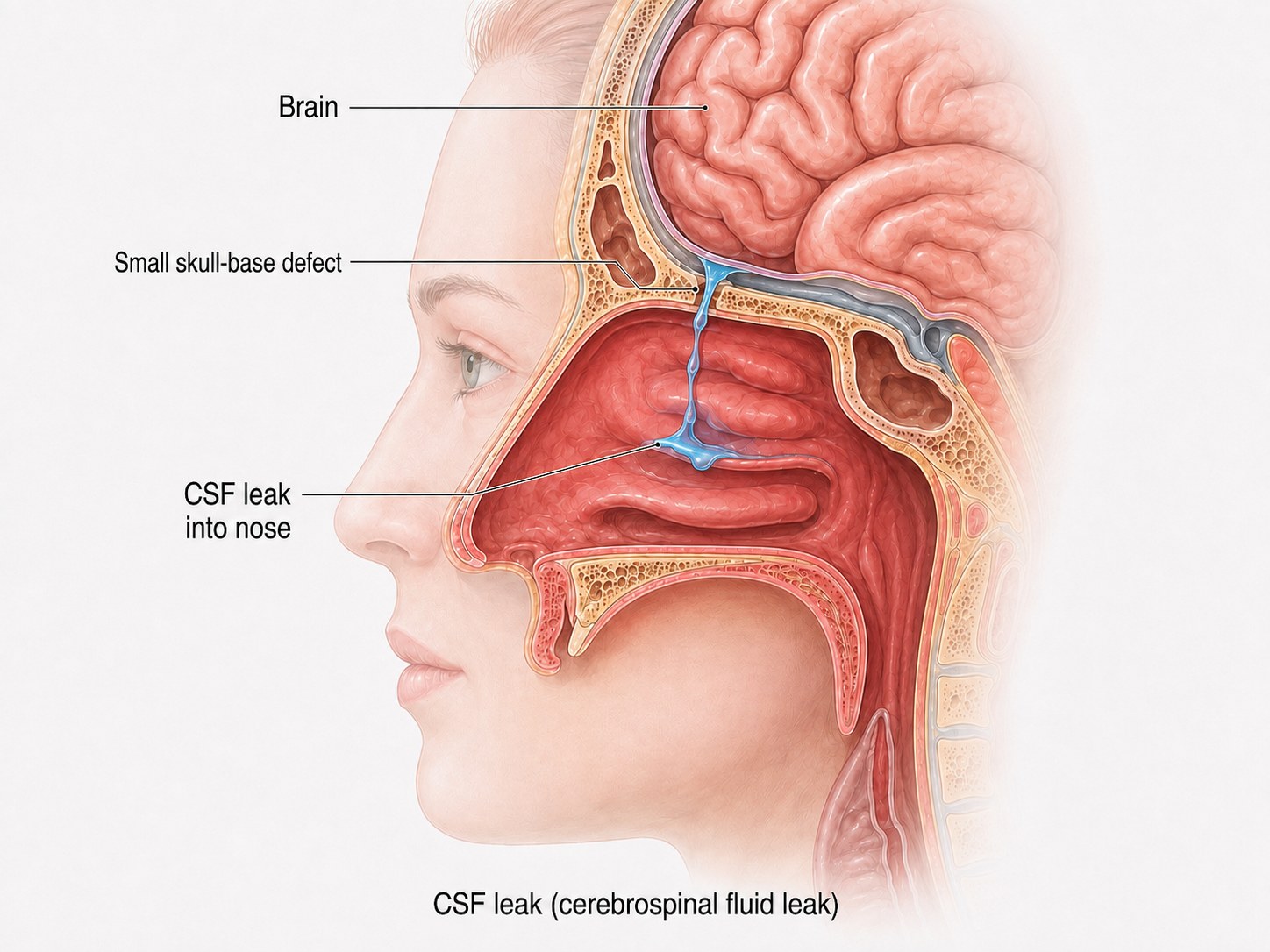
Original educational illustration created by the author; anatomy is simplified for clarity. Source: Samargandy S, 2026.
Common symptoms
- Clear, watery fluid dripping from one side of the nose, often worse when leaning forward.
- A salty taste in the back of your throat.
Why does it happen?
Causes include head injury, past sinus or skull base surgery, and high pressure around the brain. Some leaks happen without any clear cause, most often in people with higher-than-normal pressure inside the skull.
How Is a CSF Leak Diagnosed?
1. Confirm that the fluid is actually cerebrospinal fluid
A sample of the clear nasal drainage may be tested for proteins that are highly specific to cerebrospinal fluid, such as beta-2 transferrin or beta-trace protein.
2. Find where the leak is coming from
Once a CSF leak is confirmed or strongly suspected, imaging is used to localize the skull base defect.
- CT (computed tomography) imaging of the skull base and sinuses.
- MRI (magnetic resonance imaging) with contrast.
- Additional specialized imaging in selected cases if the exact site is difficult to identify.
Nasal endoscopy may help examine the nasal cavity and look for the suspected site of leakage.
Treatment
Most CSF leaks from the nose require closure. In very selected cases, a leak related to recent trauma may be observed for a short period to see if it closes on its own. Persistent leaks, spontaneous leaks, and most skull base leaks usually require surgical repair.
Endoscopic Repair
Most CSF leaks can be repaired through the nostrils using endoscopic surgery, without an external facial incision. The surgeon uses a small piece of your own tissue to seal the opening. This repair works well for most people. Finding and treating the underlying cause, like high pressure, is also important to stop the leak from coming back.
When should I seek urgent care? New clear fluid from your nose after a head injury or skull base surgery — especially with fever or headache — should be checked right away.
Why Is Treatment Important?
A persistent CSF leak creates an abnormal connection between the nose and the space around the brain. This increases the risk of meningitis, which is inflammation of the protective lining around the brain and spinal cord, called the meninges.
Confirmed CSF leaks should therefore be evaluated and treated appropriately.
Vaccination
If you have a confirmed CSF leak, make sure your pneumococcal vaccine is up to date. This helps lower the risk of meningitis. Your doctor can check which vaccine you need and when.
Frequently Asked Questions
Is every clear runny nose a CSF leak?
No. A clear runny nose is usually caused by common conditions like allergies or a cold. CSF leaks are uncommon and are more likely when the drainage is from one side, worse when leaning forward, or occurs after a head injury or sinus surgery.
Will I need brain surgery?
No. Most CSF leaks from the nose are repaired endoscopically through the nostrils, without any cuts on the face or opening of the skull from outside.
Can CSF leaks come back after repair?
It's uncommon, but leaks can recur, especially if the underlying cause, such as high pressure around the brain, isn't also addressed. This is why follow-up after repair matters.
Do I need antibiotics until surgery?
No. Antibiotics are not routinely needed while waiting for surgery. They don't prevent meningitis and are not recommended just because a CSF leak is present. If you develop signs of infection, such as fever or worsening headache, contact your doctor right away.