What are enlarged turbinates?
Turbinates are small shell-shaped parts inside your nose. They warm and moisten the air you breathe. When they swell, they can narrow your airway and make it harder to breathe through your nose. This is one of the most common causes of a blocked nose.
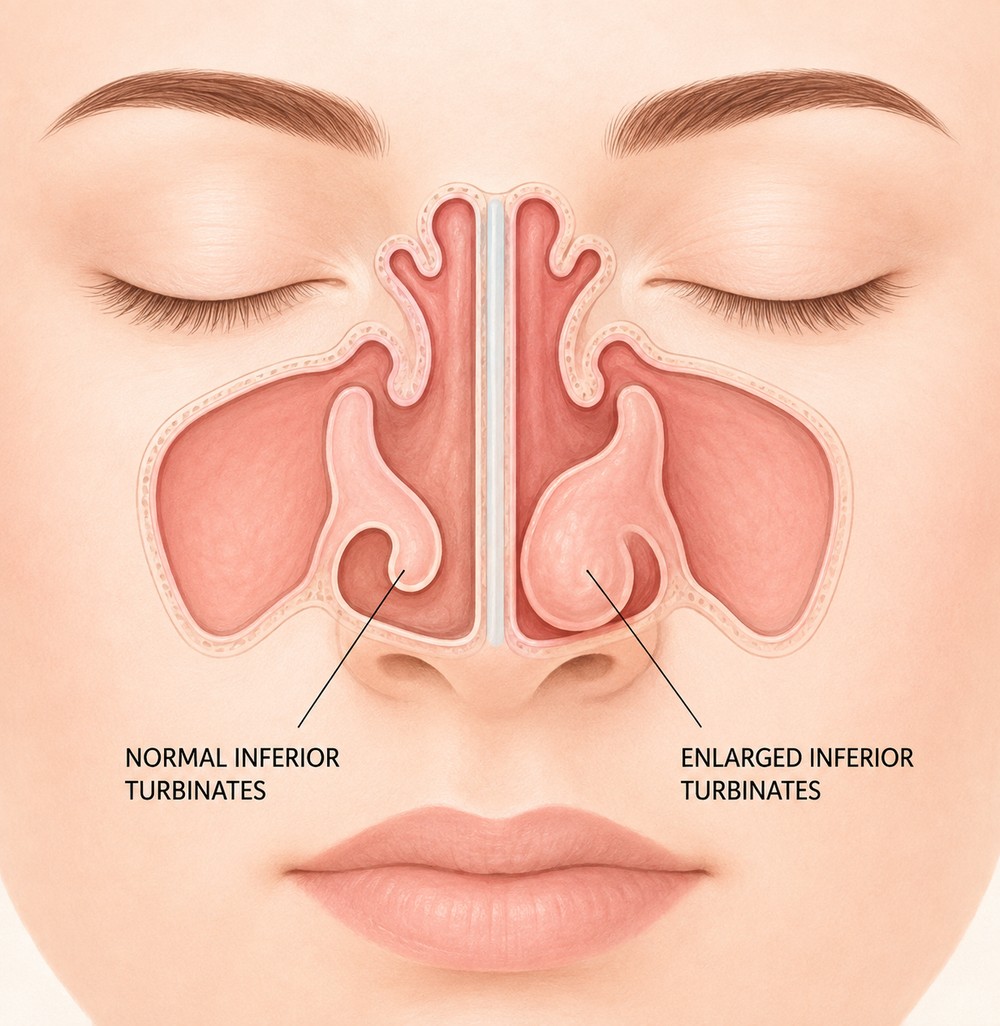
Original educational illustration created by the author; anatomy is simplified for clarity. Source: Samargandy S, 2026.
Medicine comes first
Before any procedure, we try steroid nasal sprays and saline rinses. If allergies play a part, we treat those too. Many people feel much better this way and never need anything more.
Who may be a candidate?
This may be an option if your nose stays blocked despite trying medicine, and your turbinates are only mildly to moderately swollen. Unlike surgery, coblation is done right in the clinic — not the operating room.
What is coblation?
Coblation uses a thin wand and gentle energy to shrink the swollen tissue from the inside. It doesn't remove the turbinate's outer surface. The goal is a wider airway, while the turbinate still does its normal job of warming and moistening the air.
What happens during the procedure?
This is done under local anesthesia. We numb the inside of your nose with a spray, and sometimes a small injection, so you stay awake but shouldn't feel pain — just some pressure or warmth. Each side takes about 10 to 15 minutes.
What to expect afterward
Some stuffiness and swelling in the first few days is normal — it's part of healing, not a sign of a problem. Most people go back to their normal day the same day or the next. Breathing usually improves gradually over two to four weeks, as the swelling goes down.
Risks and limits
Coblation is usually well tolerated, with a low risk of bleeding or infection. In some people, results fade over time and the procedure may need repeating. It doesn't cure allergies or ongoing inflammation — those still need their own treatment.
When is full turbinate surgery better? If your turbinates are significantly enlarged, if coblation didn't give lasting relief, or if you're already having surgery for another reason like septoplasty, a more thorough procedure in the operating room may be the better choice.