What does this mean?
The septum is the wall inside your nose that separates the two sides. If it is bent or shifted to one side, it can make one or both nasal passages narrower and make it harder to breathe through the nose.
When the inferior turbinates become enlarged, they can also take up more space inside the nasal passages and contribute to blockage.
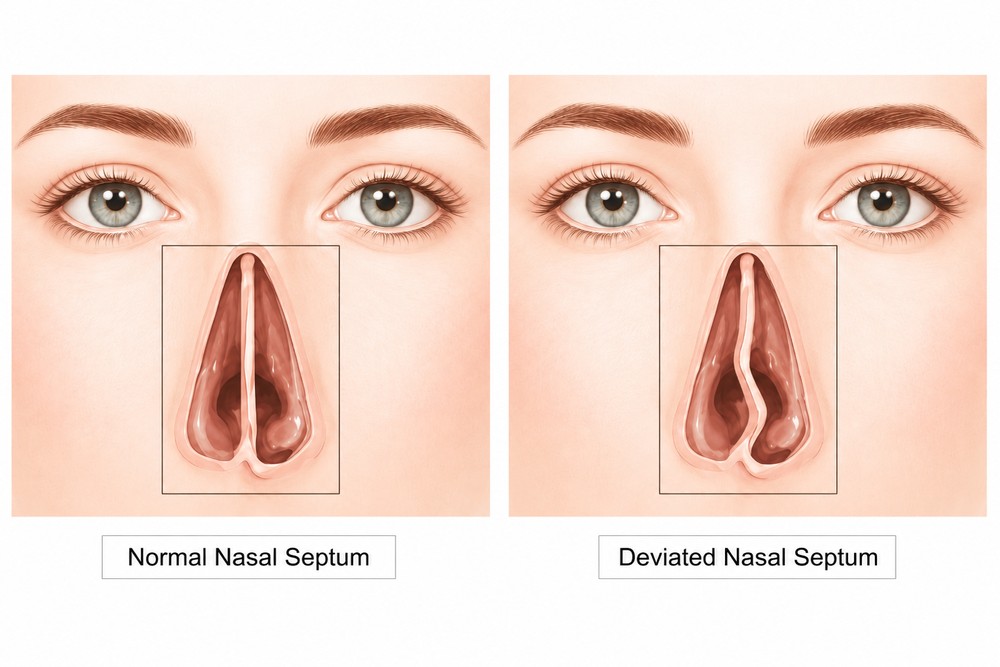
Original educational illustration created by the author; anatomy is simplified for clarity. Source: Samargandy S, 2026.
Common symptoms
- Difficulty breathing through one or both sides of the nose.
- Nasal congestion that may be worse at night or when lying down.
- Mouth breathing or dry mouth.
- Reduced airflow during exercise or sleep.
- Nasal blockage that does not fully improve with nasal sprays or other medical treatment.
How is it diagnosed?
We can see a crooked septum during a nose exam. This also helps us check if anything else is adding to the blockage, including the size of the inferior turbinates.
Treatment
A mild deviation with no real symptoms usually needs no treatment. If nasal passages are blocked and it's affecting your life, treatment may address the septum, the turbinates, or both, depending on what's contributing most to the blockage.
When is surgery considered? Surgery may be considered when nasal obstruction remains bothersome despite appropriate medical treatment and the septum and/or inferior turbinates are contributing significantly to the blockage.
Septoplasty
Septoplasty straightens the parts of the nasal septum that are narrowing the nasal passages and making it harder to breathe. It is performed inside the nose and does not change the external appearance or shape of the nose.
Frequently asked questions
Is a deviated septum common?
Yes. Many people have some degree of septal deviation. Treatment is only needed when it is causing nasal obstruction or blockage.
Can enlarged turbinates come back after treatment?
After office-based coblation, the turbinates may enlarge again over time, particularly if allergy or inflammation persists. After surgical turbinoplasty, the turbinates do not typically regrow. Ongoing nasal treatment may still be needed if allergy or inflammation continues.
Do I always need both septoplasty and turbinate surgery?
It depends. The choice depends on which structures are contributing to the nasal obstruction. Some patients need only septoplasty or turbinate surgery, while others may benefit from both procedures.