
What Are Fungi?
Fungi are organisms that are different from bacteria and viruses. They are commonly found in the environment, including in soil, dust, and the air. Small amounts may also be present in the nose and sinuses of healthy people without causing problems.
What Is Fungal Sinusitis?
Fungal sinusitis is a group of sinus conditions in which fungi are present and contribute to disease.
Types of Fungal Sinusitis
Non-invasive fungal sinusitis (contained fungal disease): the fungus may build up and push on nearby structures, but it does not grow into or destroy the surrounding tissue.
Invasive fungal sinusitis (tissue-invading fungal disease): the fungus grows into and infects the surrounding tissue, which can damage tissue and blood vessels and may spread to nearby areas.
Non-Invasive Fungal Sinusitis
Fungal Ball
A fungal ball is a collection of fungal material trapped inside one of the sinuses. Some patients have no symptoms, while others may develop pressure, drainage, an unpleasant smell, or repeated sinus problems.
Treatment is usually surgery to open and clean the affected sinus. Antifungal medication is usually not needed.
Allergic Fungal Sinusitis
Allergic fungal sinusitis is a non-invasive, chronic inflammatory sinus condition that usually occurs in otherwise healthy people. The immune system develops a strong allergic-type inflammatory response to fungi within the sinuses.
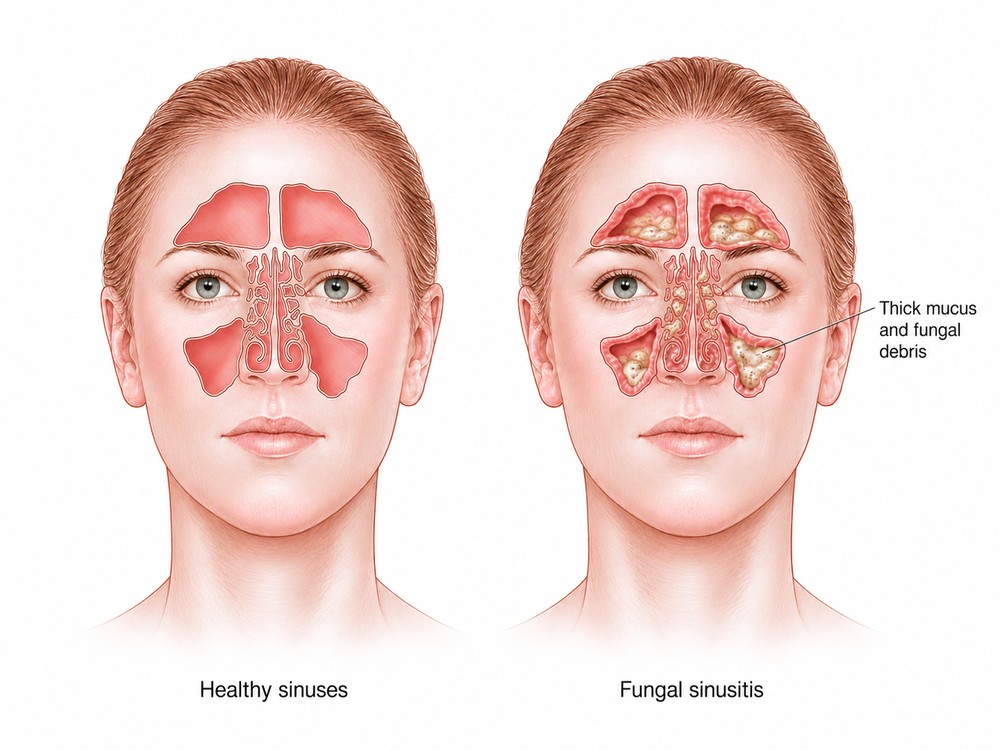
Original educational illustration created by the author; anatomy is simplified for clarity. Source: Samargandy S, 2026.
It often occurs with chronic sinusitis and nasal polyps.
Although the fungus does not invade or destroy tissue, the buildup of thick mucus and inflammation can gradually expand the sinuses and push on nearby structures. In more advanced cases, this pressure can affect the area around the eye or skull base.
Symptoms may sometimes seem surprisingly mild compared with how extensive the disease appears on imaging.
Treatment is primarily surgical. It usually requires complete endoscopic sinus surgery to remove the thick inflammatory material and fully open the affected sinuses, followed by long-term topical anti-inflammatory treatment.
Because this is a chronic inflammatory condition, it can recur, so long-term follow-up is important even when symptoms improve significantly after surgery.
Antifungal medications are not routinely recommended, because this condition is primarily an inflammatory reaction rather than an invasive fungal infection.
In selected patients with persistent or recurrent disease despite appropriate surgery and medical treatment, biologic therapy may be considered as an additional treatment option.
Saprophytic Fungal Growth
Fungus may sometimes be found growing on mucus or crusts inside the nose without infecting the tissue. It is often found incidentally and usually causes no additional symptoms. Treatment is usually not required.
Invasive Fungal Sinusitis
In invasive fungal sinusitis, the fungus actually infects and grows into the tissue, which can damage tissue and blood vessels and may spread to nearby areas.
This form is very rare and usually occurs in people whose immune system is severely weakened, such as some patients with uncontrolled diabetes, leukemia or lymphoma, organ transplantation, or significant immune suppression.
This is a medical emergency. Because invasive fungal sinusitis can progress quickly, it requires urgent antifungal treatment and surgery to remove infected tissue. Treatment of the underlying condition affecting the immune system is also important whenever possible.
How Is Fungal Sinusitis Diagnosed?
- Review of symptoms, medical history, and immune status.
- Examination of the nose, often including nasal endoscopy.
- Imaging of the sinuses using computed tomography.
- Magnetic resonance imaging when invasive disease or spread outside the sinuses is suspected.
- Samples of mucus or tissue when needed.
- Pathology examination when needed to determine whether fungus is simply present within the sinus or has invaded the tissue.
Frequently Asked Questions
Does finding fungus in my sinus mean I have an invasive fungal infection?
No. Fungus may be present in the nose or sinuses without invading tissue. Fungal ball and allergic fungal sinusitis are non-invasive conditions and are very different from invasive fungal sinusitis.
Do all types of fungal sinusitis need antifungal medication?
No. Antifungal medication is generally not needed for fungal ball and is not routinely recommended for allergic fungal sinusitis. It is an important part of treatment for invasive fungal sinusitis.
Can fungal sinusitis come back?
It depends on the type. A fungal ball usually resolves once it is completely removed and the sinus is adequately opened. Allergic fungal sinusitis can recur because it is a chronic inflammatory condition, so long-term topical treatment and follow-up are important.
Is fungal sinusitis contagious?
No. Fungal sinusitis is not spread from person to person.